“I am greatly interested in Roy and like him.”
Lavinia Goodell, January 1876
Lavinia Goodell had a reformer’s nature and throughout her life strove to help those in need, whether it desperate to extricate themselves from abusive marriages or young men who had run afoul of the law. Although Lavinia generally had good instincts about peoples’ nature, she sometimes expended energy trying to help someone who was simply beyond help. One of the most bitter disappointments of her life was her efforts to rehabilitate a young man named Roy Cameron.
Cameron first burst into Lavinia’s life on Monday, January 17, 1876. He called at her office and later came to her house where she spent the evening talking with him. While Lavinia was impressed with the young man, she confided to her diary, “Sorry to say our folks don’t feel as much interested in him as I do and think I am fooled.” As it turned out, her parents were better judges of character than she.
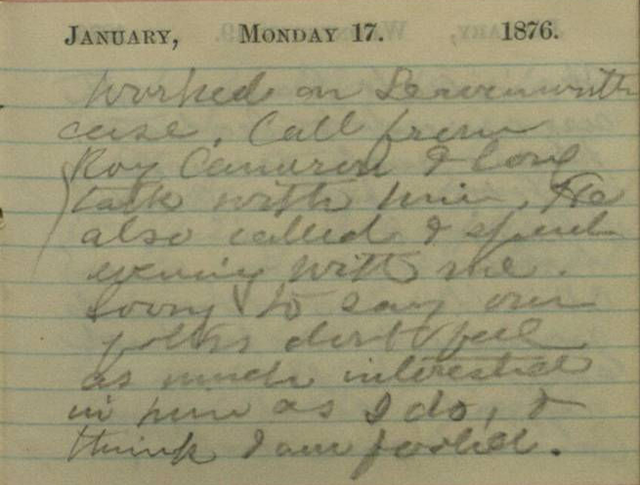
Cameron called on Lavinia again the next day, and she wrote, “I am greatly interested in Roy and like him.” Within a week, Lavinia she had her first suspicions that her initial instincts about the young man may have been wrong, saying, “Would give a good deal to know whether he told me the truth.” On February 16, 1876, the same day she learned that the Wisconsin Supreme Court had denied her petition to be admitted to practice there, Lavinia’s diary entry also noted that she had seen a newspaper article confirming her worst fears of Cameron. The article in question reported that Cameron had stolen a minister’s coat and pawned it for a night’s lodging. He was apprehended by authorities in northern Illinois and brought back to Wisconsin to face the music. He pleaded guilty to a charge of larceny and was sentenced to 30 days in the Walworth county jail.
Still, Lavinia did not abandon hope. In the months following Cameron’s arrest, she exchanged multiple letters with him and said she had high hopes for him. In May 1876 Cameron came to her office several days in a row and helped her with some cleaning. She said he “seemed real good” but “Heaven knows whether I am ‘sold’ or not.” By early June she wrote that she was happy he had left town, and “Feel depressed. Roy cheated Wheelock. No use – worse than dead – wish I’d never tried to help him.”
But hope springs eternal. In November 1876, Lavinia wrote Cameron a lengthy letter saying she had given up on him and “I so long to have you become the man you might be. I have never lost faith in that better nature I thought I saw in you at first. I am afraid you have gone the wrong way. If you will begin over & convince me by deeds that you are trying to do right, the past shall be rubbed out & forgotten, and I will write you & help you all I can, but let me have no hypocrisy or lying. I see through & hate such things.”
Although her attempts to redeem him were of no avail, Lavinia remained in sporadic contact with Cameron for the rest of her life. In 1878, when she was recuperating from cancer surgery in the East, she wrote to her sister that she had heard from him again. This time he was in a Massachusetts prison after passing himself off as someone with medical knowledge and stealing surgical instruments from several physicians. Lavinia’s last comment about him came in a letter she wrote to her cousin Sarah in December of 1879, as she was suffering increasingly poor health after moving to Madison, Wisconsin. She reported, “Had a curt note from Roy, saying that if I wouldn’t do any better by him than to write postal cards he tho’t the correspondence had best cease. So that is probably the last of him & might as well be.”
In spite of her hopes of him finding redemption and all of her efforts to point him in the right direction, Roy Cameron was a fairly rare example of someone that Lavinia Goodell was unable to help better his lot in life. But she was never known to back down from a challenge, and she tried nonetheless.