“The love of the aged is glorious.”

“The love of the aged is glorious.”

Lavinia Goodell, 1860

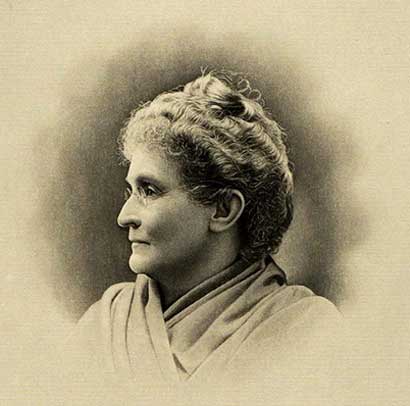
Lavinia Goodell was an astute observer, and she enjoyed writing about peoples’ relationships. In the summer of 1860, twenty-one year old Lavinia wrote a short story titled “Old Lovers” for her father’s newspaper, the Principia. The narrator of the story, a young woman, meets an elderly couple in the ladies’ sitting room of the train station in the “little village of C” in western New York. (“C” perhaps stood for Canastota, where the Goodells had relatives.)

Lavinia began, “Youthful love has been all worked up in verses and stories and essays,” “but O, why do we not hear more of old lovers? Are they so few? Does love die out with youth? Does the hard, and actual of life so over-sweep the ideal? Is love so weak, so easily overcome? Not always.”

Continue reading →
Posted by admin in Principia years, 0 comments

“Baby’s rights was the watchword.”

“Baby’s rights was the watchword.”

Maria Goodell Frost, speaking of her sister Lavinia as an infant

On May 2, 1839, Rhoda Lavinia Goodell was born in Utica, New York.

 A previous post recounted her father’s letter informing his father-in-law about the birth. Lavinia’s sister, Maria, who was twelve years old at the time, reminisced about the event in her unpublished biography of Lavinia:

Thursday, the 2nd day of May 1839 was ushered into the household a being who seemed to have pre-existed, to have experience, to have formed views on various subjects of physiology, law, government, ethics, policy, language, evolution, in short all of the varied elements that simply or combined go to make up the different phases of theory and practice in human life.  She was destined at the outset to overthrow existing institutions. 

Continue reading →
Posted by admin in Growing Up: 1839-1859, 0 comments

“If we are true to our own higher nature, we cannot fail.”

“If we are true to our own higher nature, we cannot fail.”

Lavinia Goodell, 1858

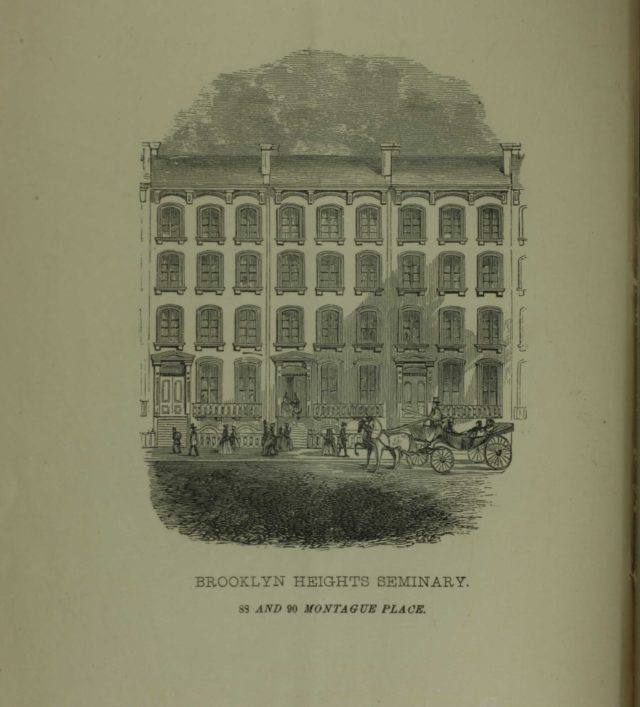
Graduation season is just around the corner. In 1858, Lavinia Goodell graduated from the Brooklyn Heights Seminary, a school for girls.

Lavinia wrote a graduation essay, which was read by a male professor at the commencement ceremony. Maria Goodell Frost included a rough draft of the essay in her unpublished biography of her sister. At age nineteen, Lavinia was still developing as a writer, but her piece clearly shows her love of learning and her optimism about the future. She began:

It is a queer place this world we find ourselves in when we first open the eyes of our minds and look about us. It is a vast unexplored field, everything a phenomenon to be studied, investigated solved.

She said, “In childhood there is a vague general idea that everything commenced with us. We are the center around which all revolves.” But as children age and have contact with others, who are also seeking after truth, “we open our hearts to them, admit them into the brotherhood.”

Continue reading →

Posted by admin in Growing Up: 1839-1859, 0 comments

“Your time could not have been improved to better advantage than by reading law.”

“Your time could not have been improved to better advantage than by reading law.”

Lavinia Goodell, September 1875

In late summer 1875, a little over a year after she was admitted to practice law in Wisconsin, Lavinia Goodell penned an article that appeared in the September 4, 1975 Woman’s Journal titled “Shall Women Study Law?” Her conclusion was a resounding “yes.”

Lavinia’s article answered six questions about the feasibility of women studying law. The first was “Had I better study? Will it pay?” Lavinia encouraged everyone having a taste for legal study and the time to devote to it to by all means study. She said, “Should you never practice, or even never complete a full course of reading, … the information thus obtained will be invaluable to you and the mental discipline is worth solid gold.”

Second, in response to the question, “What previous education is necessary?” she replied, “The more the better.” While she said a collegiate course was desirable for someone who was young and could spare the time, it was not indispensable. She held the same view of Latin study. On the other hand, she deemed “a thorough mathematical course and good knowledge of history”  necessary and touted the benefits of being well read in literature, taking a metaphysical course, and studying logic and languages.

Continue reading →
Posted by admin, 0 comments

“Folks don’t write Sundays.”

“Folks don’t write Sundays.”

Lavinia Goodell to her father, early 1840s

According to the unpublished biography of Lavinia Goodell written by her older sister, Maria Goodell Frost, Lavinia’s first experience attending church was in Whitesboro, New York. The minister was Rev. Beriah Green.

Beriah Green

Green was born in Connecticut in 1795. He became the pastor of a Congregational church in the early 1820s. By the 1830s he became acquainted with William Lloyd Garrison and became a staunch abolitionist, a calling shared by Lavinia’s father, William Goodell. In 1833, Green became the president of the Oneida Institute, a Presbyterian institution in Whitesboro, New York. Green, along with William Goodell and Alvan Stewart, were founding members of the New York Anti-Slavery society.

In 1836, in a sermon at the Whitesboro Presbyterian church, Green called American slavery “a system of fraud, adultery and murder,” and argued that the slave had been “robbed of inalienable rights.” By the late 1830s, 59 members of that church seceded over the issue of abolition and formed the Congregational Church of Whitesboro. Green served as the church’s pastor from 1843 to 1867. This was the first church that little Lavinia attended. According to Maria Frost Lavinia was excited to see Rev. Green:

A little trill of joy escaped her as her sole known friend appeared in the pulpit, for that goodly man, so like his master, who “suffered the little children to come unto him,” knew all the lambs of his flock and none better than Lavinia.

Continue reading →
Posted by admin in Growing Up: 1839-1859, 0 comments

“She shall be worth ten thousand dollars to you, Brother Goodell.”

“She shall be worth ten thousand dollars to you, Brother Goodell.”

Attorney Alvan Stewart to William Goodell, 1842

One of the first lawyers Lavinia Goodell ever met was Alvan Stewart.

Alvan Stewart, Esq.

Born in 1790 in New York State, Stewart had the reputation of a brilliant lawyer. Alvan Stewart moved to Utica in 1832, and the Goodell family was living in Utica at the time of Lavinia’s birth in 1839. In addition to his law practice, Stewart was active in the anti-slavery and temperance movements, as was William Goodell.

In 1842, when Lavinia was three years old, Stewart was a candidate for New York governor on the Liberty party ticket. According to Lavinia’s sister, Maria Goodell Frost, who was a teenager at the time, one evening Mrs. Goodell announced that Stewart would be paying them a visit. William Goodell said he was “very glad he was coming” as he “wished to speak with him on some points of law.”

Little Lavinia, who by all accounts was a rather difficult child, allowed herself to be washed and dressed in a dignified way so as to be ready to meet the distinguished guest.

Continue reading →
Posted by admin in Growing Up: 1839-1859, 1 comment

“The future for women law graduates is bright”

“The future for women law graduates is bright”

Emily Kempin-Spyri, first woman law graduate in Switzerland, 1888

Arabella Mansfield is often cited as the first woman lawyer in the United States, gaining admission to the bar in 1869 (although she never practiced). By the time Lavinia Goodell was admitted to practice law in Wisconsin in 1874, she joined a small coterie of a dozen or so other American women. A previous post featured Lidia Poët, Italy’s first woman lawyer. The first Swiss woman to earn a law degree was Emily Kempin-Spyri.

Emily Kempin-Spyri

Emily Spyri was born in 1853. She was the niece of Johanna Spyri, the author of Heidi. She was born into a wealthy family but married against her father’s wishes. Her husband, pastor and social reformer Walter Kempin, supported her aspirations to become a lawyer. She graduated from the University of Zurich’s law school in 1883 and earned a doctoral degree, summa cum laude, in 1887. However, she was denied the right to practice because she was not an “active citizen” of Switzerland. The Swiss constitution required a citizen to pay taxes and serve in the military, which excluded women. After her appeal to the Supreme Court but was denied, she came to New York where there were greater opportunities for women lawyers. In order to familiarize herself with American law, she applied for admission to Columbia College Law School. It was four months before her request was denied, but in the meantime she had been quietly attending the school’s lectures. New York University allowed her to attend law classes, as a courtesy to the University of Zurich, with the understanding that her attendance would create no precedent for other women. Unfortunately, she was denied admission to the New York City bar association because she was a foreigner. She then co-founded a free legal clinic for the poor and soon afterward decided to establish a law school for women.

Brooklyn Times Union, October 5, 1888
Continue reading →
Posted by admin, 0 comments

“Dined with Dr. Wolcott”

“Dined with Dr. Wolcott”

Lavinia Goodell, October 17, 1879

Lavinia Goodell was acquainted with many pioneering women of her day, including Dr. Laura Ross Wolcott, Wisconsin’s first woman physician.

Dr. Laura Ross Wolcott

Laura Ross was born in Maine in 1826. She graduated from the Women’s Medical College of Pennsylvania in 1856 and was the third woman in the U.S. to earn a medical degree. (Janesville, Wisconsin gained a woman physician in 1878 when Dr. Clara Normington set up practice there.) Dr. Ross moved to Milwaukee in 1857, but was denied admittance to the Medical Society of Milwaukee County because she was a woman. She went to Paris in 1867,  and sat in on lectures at the Sorbonne and worked in a hospital. She returned to Milwaukee and was admitted to the Milwaukee County Medical Society in 1869, in part due to the support of an older physician, Erastus Wolcott, whom she married that same year.

1869 was a busy year for Dr. Wolcott since in addition to being admitted to the Medical Society and getting married, she helped organize a woman’s rights convention in Milwaukee (Lily Peckham, who was an aspiring lawyer and later became a minister also participated in the convention) and was a founder of the Wisconsin Woman’s Suffrage Association, serving as its president until 1882.

The Milwaukee newspaper the Semi-Weekly Wisconsin, described the 1869 convention as follows:

February 27, 1869 Semi-Weekly Wisconsin
Continue reading →
Posted by admin in Life in Wisconsin: 1871-1880, Women's rights, 0 comments