“The devil has come down in great wrath knowing that his time is short.”

“The devil has come down in great wrath knowing that his time is short.”

Lavinia Goodell, February 29, 1872

In early 1872, media accounts – especially on the east coast – were abuzz with the scandalous story that a woman had been allowed to preach in a Brooklyn Presbyterian church. The brazen woman in question was Sarah Smiley, a Quaker.

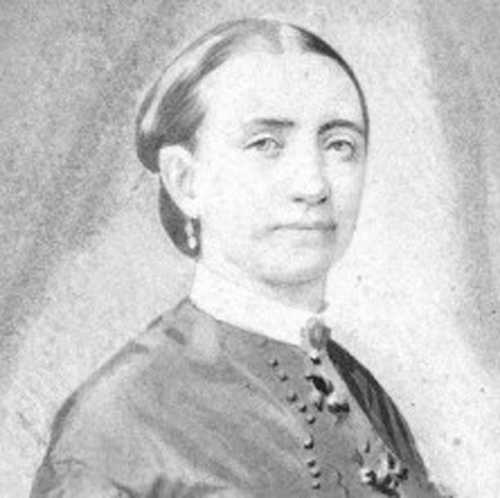
Sarah Smiley

Ms.  Smiley was born in Maine in 1830. She initially wanted to become a teacher but after the Civil War went South to “relieve human suffering.” She later began speaking to audiences and eventually was invited to speak in liberal-minded churches. In January 1872 she became the first woman to ever speak in a Presbyterian church when Rev. Theodore Cuyler invited her to address his congregation in Brooklyn. Rev. Cuyler had lived with Quakers and had been invited to address a Friends revival meeting in Brooklyn, so in return he invited Ms. Smiley to speak from his pulpit on a Sunday evening.

By all accounts Ms. Smiley’s address was well received (she spoke about the vision of Jacob wrestling with an angel), and it is unlikely that either she or Rev. Cuyler could have anticipated the firestorm that soon followed.  Two days after the event a scathing letter signed by Jon Edwards appeared in the Brooklyn Daily Eagle. Mr. Edwards accused Rev. Cuyler of “degrading the teachings of St. Paul.” He wrote:

This is no time to encourage even in the remotest way the pretensions of those graceless women who are engaged in the unholy work of turning society upside down, and whom I hear in our families and social gatherings, ridiculing St. Paul as an old Jewish bachelor, unworthy of respect.

Continue reading →
Posted by admin, 0 comments

“Miss Lily Peckham is now preparing herself for the ministry.”

“Miss Lily Peckham is now preparing herself for the ministry.”

Juniata Sentinel (Mifflintown, Pennsylvania), January 4, 1871

A previous post discussed Lily Peckham (1843-1871), who was active in the woman’s rights movement and who may or may not have briefly practiced law in Milwaukee.

Lily maintained a busy schedule in the last two years of her life. According to newspaper accounts, she attended and spoke at women’s rights conventions in Chicago, St. Louis, Boston, New York, and Providence, R.I. Reporters complimented her speeches but also commented on her appearance, with the Chicago Evening Post referring to her as “the beautiful and bewitching Milwaukee lawyeress,” and an Iowa newspaper touting her “lady-like appearance and manner and intellectual cast of features.”

Lily contributed to and was a Milwaukee agent for the Revolution, the official publication of the National Woman Suffrage Association formed by Elizabeth Cady Stanton and Susan B. Anthony to secure a suffrage through a federal constitutional amendment.

The Revolution, Nov. 4, 1869
Continue reading →
Posted by admin, 0 comments

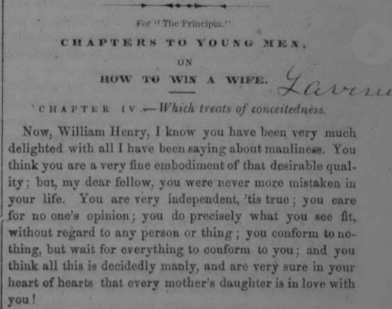
“You are nothing but what you aspire to be.”

“You are nothing but what you aspire to be.”

Lavinia Goodell, May 5, 1860

The fourth installment in Lavinia Goodell’s series of humorous articles giving young men advice on how to win a wife was published in the Principia  (her father’s anti-slavery newspaper) the week of her twenty-first birthday in 1860. With the Civil War looming on the horizon, the paper’s early pages contained an article by Rev. Henry Cheever titled “Way-marks in the moral war with slavery,” which discussed whether churches should excommunicate slaveholders, and a long letter from Thaddeus Hyatt titled “A word from the Washington jail.”( Hyatt was a staunch abolitionist who was imprisoned after refusing to testify about his knowledge of John Brown’s failed raid on Harper’s Ferry. ) In the face of such somber news, Lavinia’s pithy articles no doubt provided a breath of fresh air to Principia readers. She began:

Continue reading →
Posted by admin, 0 comments

“I screamed ‘Fire’ and called to Pa”

“I screamed ‘Fire’ and called to Pa”

Lavinia Goodell, December 28, 1853

Fourteen-year-old Lavinia Goodell experienced two harrowing events in December of 1853. On December 10, while working in her father’s offices in lower Manhattan she witnessed the huge fire that destroyed Harper & Brothers publishing company. On December 28 she was again helping her father when a fire broke out in the next room.

William Goodell had moved to Brooklyn with his wife and daughter earlier in the year and began publishing American Jubilee, an anti-slavery publication, at 84 Beekman Street, in what is now New York’s financial district.

Continue reading →
Posted by admin, 0 comments

“She succeeded far beyond my utmost expectations.”

“She succeeded far beyond my utmost expectations.”

Allan Pinkerton’s comment on Kate Warne

Although Lavinia Goodell and Kate Warne never met, in February of 1861 they shared a common interest: following the progress of Abraham Lincoln’s journey from Springfield, Illinois to Washington, D.C.  On the afternoon of February 19,  twenty-one year old Lavinia joined throngs of other New Yorkers to watch the president-elect’s carriage procession in mid-town Manhattan. (Read her account here.)

While Lavinia was in Manhattan, Kate Warne, who was approximately twenty-eight years old and was in charge of the famous Pinkerton Detective Agency’s Female Detective Force, was in Baltimore trying to ascertain if there were credible threats to Lincoln’s safety. It turned out that there were, and Kate helped thwart them.

Kate Warne
Continue reading →
Posted by admin, 0 comments