“Petition denied.”

“Petition denied.”

One hundred fifty years ago, the Wisconsin Supreme Court issued one of its most famous – and infamous – decisions. The afternoon edition of the Tuesday, February 15, 1876 Wisconsin State Journal contained a list of the opinions the court had handed down earlier that day. Two of those opinions were written by Chief Justice Edward Ryan. The first was a routine matter: the denial of a writ of mandamus. The second was the denial of Lavinia Goodell’s motion to become the first woman admitted to the bar of the Wisconsin Supreme Court. Although the opinion was authored by Chief Justice Ryan, the other two justices agreed that Wisconsin statutes permitted only men to practice law. In all likelihood, the justices viewed this case as a run-of-the-mill application of the principles of statutory interpretation. Little did they know that their ruling would set in motion a course of events that would forever change the practice of law in Wisconsin.
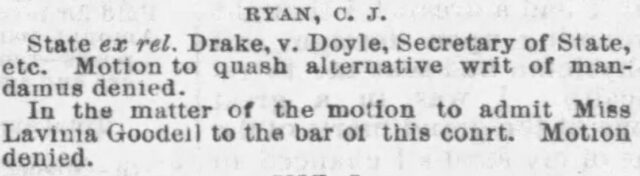
February 15, 1876 Wisconsin State Journal

Lavinia learned of the decision the following day and made the terse notation in her diary, “Am refused admittance to Sup. Ct.”

Lavinia had lost this battle and was bitterly disappointed, but she was by no means defeated, and her persistence led, thirteen months later, to a change in the law that specifically stated that no person in Wisconsin may be denied a license to practice law on account of sex. Generations of women lawyers have benefitted from her firm stance against the exclusion of women from the legal profession.

Continue reading →

Posted by admin, 0 comments

Where is the line to be drawn between “you may do this” and “you must not do that”?

Where is the line to be drawn between “you may do this” and “you must not do that”?

Henry Ward Beecher, March 1876

One hundred fifty years ago, Henry Ward Beecher was one of the most famous men in the United States. The Brooklyn, New York Congregationalist preacher was a lifelong proponent of equal rights for women. He was also a personal friend of Lavinia Goodell, Wisconsin’s first woman lawyer. (Read more about Lavinia’s relationship with Beecher here.) So it was not surprising that when the Wisconsin Supreme Court refused to allow Lavinia to practice before it due to her gender, Beecher wrote a strong rebuke in his weekly paper, The Christian Union.

He wrote:

Has woman the right to earn her own living in her own way? Reduced to its practical shape this is the question which the Wisconsin Supreme Court has decided in the negative in refusing to admit Miss Lavinia Goodell to practice at its bar. The old common law, it seems is to blame for this; at least their “honors” fall back upon it in the absence of an express statute authorizing the gentler sex to enter the legal profession.

Continue reading →
Posted by admin, 1 comment

“Whoever heard of a woman so rich as to be possessor of both a mind and heart?”

“Whoever heard of a woman so rich as to be possessor of both a mind and heart?”

Lavinia Goodell, 1870s

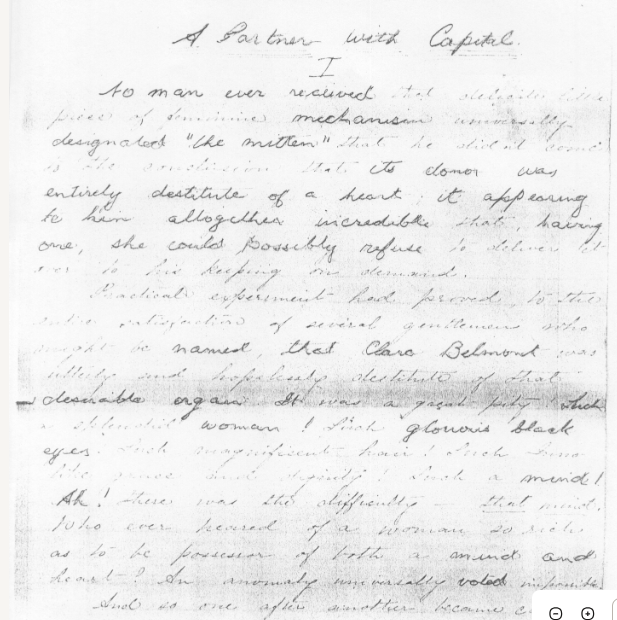
The William Goodell family papers housed in the Special Collections and Archives of Berea College in Berea, Kentucky contain a draft of a short story written by Lavinia Goodell titled “A Partner With Capital.”

First page of “A Partner With Capital”

The story is undated, but following Lavinia’s signature at the end is the notation “Janesville, Wis,” which would mean it was written between late 1871 and late 1879. An educated guess would place it in the early 1870s, before Lavinia began her legal studies, since once she embarked on that path she had little time for other frivolous undertakings, and a 28-page short story could not have been dashed off in short order.

Continue reading →
Posted by admin in Articles, 1 comment

“What a splendid woman Charlotte Bronte was!”

“What a splendid woman Charlotte Bronte was!”

Lavinia Goodell, March 18, 1863

Lavinia Goodell lived 150 years ago, but some topics being discussed in today’s press would be familiar to her. A case in point is a recent New York times article about a poetry anthology titled “Book of Rhymes” that was written by the author Charlotte Bronte when she was 13 years old.

Charlotte Bronte

Bronte wrote the poems on tiny scraps of paper and stitched them together. The little volume sold for $1.25 million in 2022 and has recently been published by the Bronte Parsonage Museum in England and made available to the public for the first time.

Continue reading →
Posted by admin in Reading interests, 0 comments

I felt “set up” by my success

I felt “set up” by my success

Lavinia Goodell, December 1874

In December 1874, six months after her admission to practice law, Lavinia Goodell kept busy not only running her law office but also speaking to temperance groups. Several days before Christmas, Lavinia wrote to her sister saying that the previous week she had accepted an invitation to lecture at Whitewater, Wisconsin. She said, “I was considerably alarmed at the prospect but concluded to accept. I shall have to learn to speak if I am going to make much of a lawyer.” She wrote her lecture out because she did not trust herself to make impromptu remarks. The title of her talk was “The Relation of Government to the Liquor Traffic.” She took the train from Janesville to Whitewater and several Whitewater temperance ladies met her at the depot. She said, “I had a crowded audience, and an attentive one, which applauded me generously. Didn’t feel as much scared as I expected to, and got along very well.”

Continue reading →
Posted by admin in Legal practice, Speeches, 0 comments

“Married women today are not the abject slaves they were fifty years ago”

“Married women today are not the abject slaves they were fifty years ago”

Lavinia Goodell, October 1879

In the fall of 1879, Lavinia Goodell wrote an article for the Woman’s Journal titled “How it Looked to a Lawyer Half a Century Ago.” In it, she lauded the progress women had made during her lifetime (Lavinia was born in 1839) in gaining more rights.

Lavinia noted that in 1837, Timothy Walker, a professor at the Law Department of Cincinnati College delivered a course of lectures on American Law that were published in book form in 1837.  Walker commented, “With regard to political rights, females form a positive exception to the general doctrine of equality. They cannot vote, nor hold office. We require them to contribute their share in the ay of taxes, or the support of government, but allow them no void in its direction.” Walker said if males were treated in this fashion, it “would be the exact definition of political slavery.”   But he said, “probably the most refined and enlightened [women] would be the last to desire a change which would involve them in the turmoil of politics.”

Continue reading →
Posted by admin, 0 comments

“It is real fun to be a lawyer.”

“It is real fun to be a lawyer.”

Lavinia Goodell, August 21, 1874

The early days  of Lavinia Goodell’s legal practice were busy ones.  After being admitted to practice law on June 17, 1874, she was eager to get to work and was willing to take on any clients who wanted to hire her. Lavinia’s diary entries and letters make clear that she was throwing herself into her practice with great enthusiasm and she truly enjoyed being a lawyer.

In August 1874 she tried her first cases to the court after being retained by Jefferson County temperance women to prosecute saloon keepers dealers who violated the law by selling liquor on Sundays.  She won those cases. (Read more here.) She proudly wrote to her sister, “I am not afraid of the liquor men.  I only wish I had plenty of such cases and could win them all. . . . Run away from them and they will run after you, but give them chase and they will run the other way.”

Continue reading →
Posted by admin, 1 comment

“Little by little, but all the time, we are gaining essential rights.”

“Little by little, but all the time, we are gaining essential rights.”

Woman’s Journal, March 1877

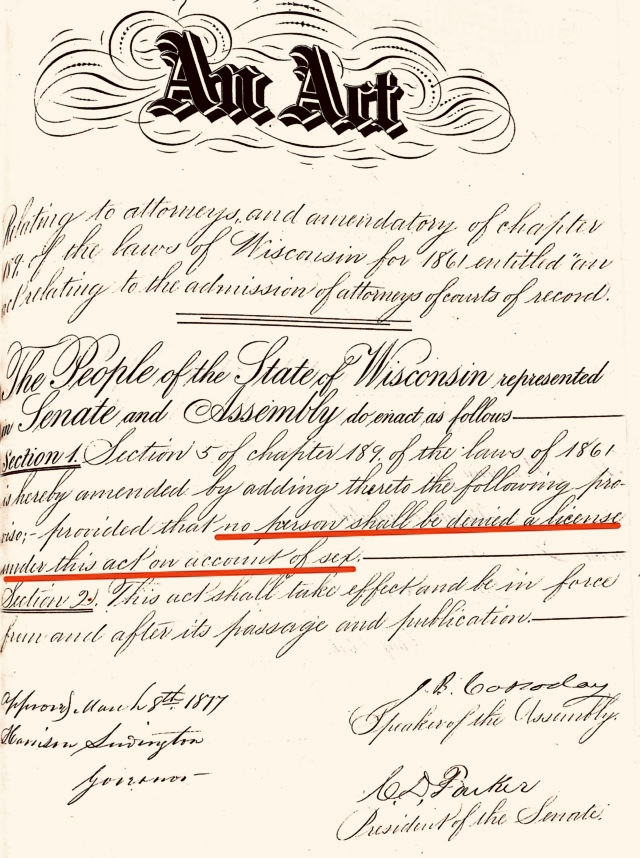
March 8 is Women’s History Day. By happy coincidence, March 8 is also the anniversary of the day that Wisconsin’s governor signed into law legislation drafted by Lavinia Goodell allowing women to practice law in the state.

After Lavinia’s petition to be allowed to practice before the Wisconsin Supreme Court was denied in early 1876 (read more about that here), Lavinia drafted legislation that permitted people of both genders to practice law. Her Janesville colleague John Cassoday , who was speaker of the assembly, introduced the bill for her. In early 1877, Lavinia took the train to Madison where Cassoday introduced her to legislators, although the meetings apparently got off to an inauspicious start. On February 6, Lavinia noted in her diary, “Spent a stupid afternoon in Cassoday’s room waiting for men to come to me and finally had  go to them.”

Continue reading →
Posted by admin in Legal practice, 0 comments