“I am filled with horror at the idea of you not having any reading.”
Lavinia Goodell to Maria Frost, March 10, 1867
The Goodell family was very well read, and their letters frequently mentioned their current literary selections. When Lavinia’s sister Maria Frost and her family moved from New York state to Janesville, Wisconsin in the late 1860s, Maria found herself missing many of the amenities of life in the east, especially the lack of a public library. Lavinia was horrified that Janesville had no library and offered her sister some suggestions:
Lavinia Goodell’s letter to Maria Frost, March 10, 1867
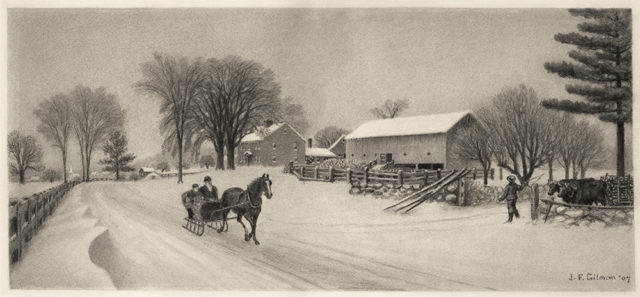
“I suppose your mother has told you of our tip over going to the society.”
Sarah Thomas to Lavinia Goodell, February 9, 1866
Researching mid-nineteenth century history gives one an appreciation for the many modern conveniences we all take for granted. Reliable transportation for one. It is unlikely that Lavinia Goodell’s parents ever owned a horse. They walked to nearby destinations and took the train or a stagecoach when travelling farther afield.
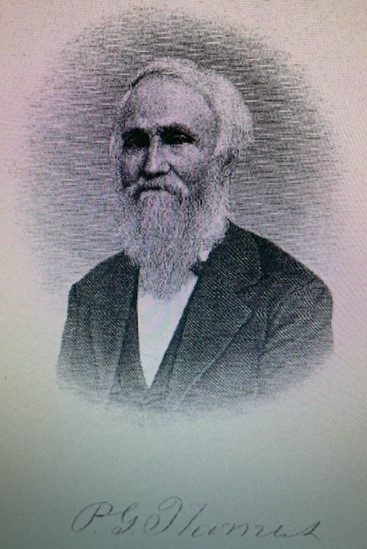
From 1865 until 1870, Lavinia’s parents lived with Mrs. Goodell’s sister’s family in Lebanon, Connecticut. Lavinia’s uncle P.G. (Peleg George) Thomas was a farmer, and he had horses, a carriage, and a sleigh.
P.G. Thomas, Lavinia Goodell’s uncle
One day in early February 1866, Uncle George Thomas set out in his sleigh with his wife, Mary, daughter Sarah Thomas, and Lavinia’s mother Clarissa, intending to convey the ladies to a sewing society meeting. Unfortunately their plans went awry.
Although Lavinia Goodell had no illusions that she was a beauty – in fact, she frequently commented that she was “plain” and many of her short stories feature ordinary looking women with uncommon intelligence – she enjoyed dressing well and kept up with current fashion trends. For most of her life money was in short supply and she sewed her own garments – after determining where the fabric could be procured for the best price. But while she was employed at Harper’s Bazar, she had enough discretionary income to splurge on new clothes. In April 1871, she made an extravagant purchase from Stewart’s dry goods store.
NEW YORK: STEWART’S, 1862. The ‘Iron Palace,’ A.T. Stewart & Company’s department store on Broadway and Ninth Street, New York. Line engraving, c1862.
Irish entrepreneur A.T. Stewart had opened his first store in 1846 at Broadway and Chambers Streets in New York. It was so ostentatious that it was called the Marble Palace. In 1863 Stewart opened what was dubbed the Iron Palace at Broadway between Ninth and Tenth Streets. It was there that Lavinia made her purchase.
“The Brooklyn sanitary fair was a magnificent affair.”
Lavinia Goodell, March 10, 1864
In 1864, Lavinia Goodell was living in Brooklyn with her parents and working with her father in editing the Principia anti-slavery newspaper. In her spare time, Lavinia enjoyed taking in cultural events and expositions. In March of 1864, along with thousands of other people, she visited the Brooklyn sanitary fair.
During the Civil War, sanitary fairs were held to raise money for the war effort in major cities in the Northeast. (Read more about them here.) The fairs combined entertainment, education, and philanthropy. Although the United States Sanitary Commission was headed by men, most of its work was accomplished by thousands of women volunteers. In Brooklyn, the hugely successful sanitary fair raised $400,000, well above the projected $100,000. The money was used for clothing, food, medical supplies, and other provisions for the Union Army.
“Mind proudly asserts its superiority over matter.”
Lavinia Goodell, December 1859
Lavinia Goodell’s contributions to the Principia, her father’s anti-slavery newspaper, have been discussed in prior posts. (Click here and here to learn more.) None of Lavinia’s pieces bear her full name. We first learned that Lavinia wrote articles for the Principia when we reviewed an unpublished biography written by Elisabeth S. Peck, a long time history teacher at Berea College in Berea, Kentucky, where the William Goodell family papers are housed. Ms. Peck mentioned the titles of some of Lavinia’s Principia pieces, and that set us on the path of trying to uncover as many as we can. (The photo of the woman we call the “faux Lavinia” made its way to Berea because of Ms. Peck. Read more about that here.)
One of Lavinia’s early contributions to the Principia appeared in the December 31, 1859 issue. The story, written when Lavinia was twenty years old, is titled “Meditation on Darning a Rent in My Dress,” and is signed “Housekeeper.” A digital version of the Principia is available in a massive database called Slavery and Anti-Slavery: A Transnational Archive, published by Gale Publishing Company. Lest there be any doubt that Lavinia Goodell actually wrote ”Meditation,” the Principia issue scanned by Gale has “Lavinia Goodell” written at the beginning of the piece in what looks like it could be Lavinia’s hand.
“It is very proper for a man of fourscore to be so honored.”
Josiah Cady to Lavinia Goodell, July 14, 1854
Deacon Josiah Cady, Lavinia Goodell’s maternal grandfather, was born in Killingly, Connecticut in 1774. He lived in Providence, Rhode Island much of his adult life. An 1830 census listed his occupation as shoemaker.
Josiah played a prominent role in the Goodell family. William Goodell, Lavinia’s father, was boarding with Josiah in Providence in 1812 when he met – and became smitten with – Josiah’s daughter Clarissa. William and Clarissa married in 1823. William Goodell’s father died when William was young, and Josiah Cady became a surrogate father to him. Scores of letters between the two men survive, and they always referred to each other as “Father” and “Son.”
Sometime before 1850, Josiah had moved to Lebanon, Connecticut and was living with his daughter and son-in-law, Mary and Peleg Thomas, and their children, one of whom was Lavinia’s close confidante, Sarah Thomas. Although there is scant record of communication passing between Lavinia and Josiah, a letter from 1854 recently came to light that indicates a true affection existed between fifteen year old Lavinia and her seventy-nine year old grandfather.
Josiah Cady’s letter to Lavinia Goodell July, 1854
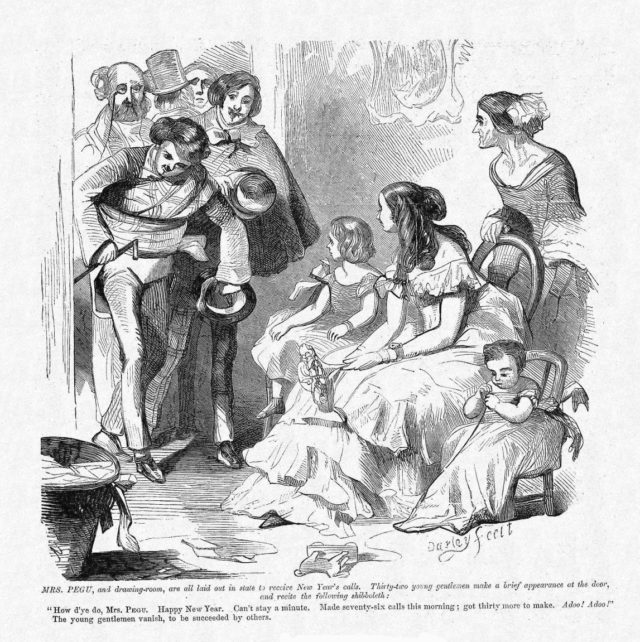
“I followed the custom of the City by calling on several acquaintances.”
William Goodell, January 5, 1827
During the nineteenth century, it was customary to make social calls on New Year’s Day. While ladies remained at home to receive guests, gentlemen made the rounds of households in their circle.
Lavinia Goodell’s family maintained this tradition throughout her lifetime. Her diary entry for January 1, 1873 reported, “Father made calls” while she and her mother “prepared for calls but received only one.”
“Wouldn’t it be dreadful to have a drunkard for a father?”
“Susy’s Christmas” by Lavinia Goodell, published in the Principia January 1, 1863
Lavinia Goodell was an active participant in the temperance movement. In 1873 she helped form Janesville’s Ladies Temperance Union. In 1875, she ran for Janesville city attorney on the temperance ticket. (Although she was unsuccessful, she got 60 votes at a time when only men could cast ballots.)
Lavinia’s temperance advocacy began in her youth, and her short stories sometimes dealt with the evils of excessive drinking. The January 1, 1863 issue of the Principia, her father’s anti-slavery newspaper, contained a short story titled “Susy’s Christmas,” in which two privileged children ask their Aunt Kate for a Christmas day story and are rewarded with a tale about an unfortunate young girl named Susy.