“Petition denied.”

“Petition denied.”

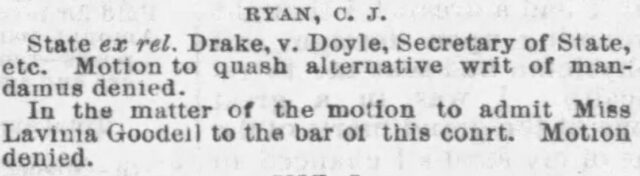
One hundred fifty years ago, the Wisconsin Supreme Court issued one of its most famous – and infamous – decisions. The afternoon edition of the Tuesday, February 15, 1876 Wisconsin State Journal contained a list of the opinions the court had handed down earlier that day. Two of those opinions were written by Chief Justice Edward Ryan. The first was a routine matter: the denial of a writ of mandamus. The second was the denial of Lavinia Goodell’s motion to become the first woman admitted to the bar of the Wisconsin Supreme Court. Although the opinion was authored by Chief Justice Ryan, the other two justices agreed that Wisconsin statutes permitted only men to practice law. In all likelihood, the justices viewed this case as a run-of-the-mill application of the principles of statutory interpretation. Little did they know that their ruling would set in motion a course of events that would forever change the practice of law in Wisconsin.

February 15, 1876 Wisconsin State Journal

Lavinia learned of the decision the following day and made the terse notation in her diary, “Am refused admittance to Sup. Ct.”

Lavinia had lost this battle and was bitterly disappointed, but she was by no means defeated, and her persistence led, thirteen months later, to a change in the law that specifically stated that no person in Wisconsin may be denied a license to practice law on account of sex. Generations of women lawyers have benefitted from her firm stance against the exclusion of women from the legal profession.

Continue reading →
Posted by admin, 0 comments

Where is the line to be drawn between “you may do this” and “you must not do that”?

Where is the line to be drawn between “you may do this” and “you must not do that”?

Henry Ward Beecher, March 1876

One hundred fifty years ago, Henry Ward Beecher was one of the most famous men in the United States. The Brooklyn, New York Congregationalist preacher was a lifelong proponent of equal rights for women. He was also a personal friend of Lavinia Goodell, Wisconsin’s first woman lawyer. (Read more about Lavinia’s relationship with Beecher here.) So it was not surprising that when the Wisconsin Supreme Court refused to allow Lavinia to practice before it due to her gender, Beecher wrote a strong rebuke in his weekly paper, The Christian Union.

He wrote:

Has woman the right to earn her own living in her own way? Reduced to its practical shape this is the question which the Wisconsin Supreme Court has decided in the negative in refusing to admit Miss Lavinia Goodell to practice at its bar. The old common law, it seems is to blame for this; at least their “honors” fall back upon it in the absence of an express statute authorizing the gentler sex to enter the legal profession.

Continue reading →
Posted by admin, 1 comment

“Married women today are not the abject slaves they were fifty years ago”

“Married women today are not the abject slaves they were fifty years ago”

Lavinia Goodell, October 1879

In the fall of 1879, Lavinia Goodell wrote an article for the Woman’s Journal titled “How it Looked to a Lawyer Half a Century Ago.” In it, she lauded the progress women had made during her lifetime (Lavinia was born in 1839) in gaining more rights.

Lavinia noted that in 1837, Timothy Walker, a professor at the Law Department of Cincinnati College delivered a course of lectures on American Law that were published in book form in 1837.  Walker commented, “With regard to political rights, females form a positive exception to the general doctrine of equality. They cannot vote, nor hold office. We require them to contribute their share in the ay of taxes, or the support of government, but allow them no void in its direction.” Walker said if males were treated in this fashion, it “would be the exact definition of political slavery.”   But he said, “probably the most refined and enlightened [women] would be the last to desire a change which would involve them in the turmoil of politics.”

Continue reading →
Posted by admin, 0 comments

Welcome to the Lavinia Goodell State Law Library

Welcome to the Lavinia Goodell State Law Library

On September 30, 2024, the Wisconsin State Law Library, located in the Risser Justice Center just off the Capitol square in Madison, Wisconsin, was named in honor of Lavinia Goodell, Wisconsin’s first woman lawyer.

As Wisconsin Supreme Court Justice Ann Walsh Bradley noted in her remarks at the naming ceremony, Lavinia cherished libraries.  In 1867, when Lavinia was living in Brooklyn, New York, her older sister, Maria Frost, was preparing to move to Janesville, Wisconsin.  Maria reported to Lavinia that Janesville had no public library.  Lavinia could scarcely believe this was true.  She wrote:

I am filled with horror at the idea  of you not having any reading in Wisconsin, and have been forming plans for the amelioration of your condition. Intellectual starvation is quite as painful as physical, tho’ it doesn’t excite the sympathies of the world so much and must not be allowed in this enlightened country, in the full blaze and glory of the Nineteenth Century. Here I am surfeited with more reading than I get time to enjoy. I have recently joined the new Brooklyn Library Association. It is splendid. There is a nice comfortable reading room, with tables, upon which you find all the principal daily and weekly papers, also thirty or forty of our best magazines, both American and Foreign, besides the New American Cyclopedia and a variety of books of every description that members can take out for two weeks. It only costs $8.00 per year, besides $1.00 initiation fee to be a member and enjoy all the privileges of the library.

Continue reading →
Posted by admin, 0 comments

“It is real fun to be a lawyer.”

“It is real fun to be a lawyer.”

Lavinia Goodell, August 21, 1874

The early days  of Lavinia Goodell’s legal practice were busy ones.  After being admitted to practice law on June 17, 1874, she was eager to get to work and was willing to take on any clients who wanted to hire her. Lavinia’s diary entries and letters make clear that she was throwing herself into her practice with great enthusiasm and she truly enjoyed being a lawyer.

In August 1874 she tried her first cases to the court after being retained by Jefferson County temperance women to prosecute saloon keepers dealers who violated the law by selling liquor on Sundays.  She won those cases. (Read more here.) She proudly wrote to her sister, “I am not afraid of the liquor men.  I only wish I had plenty of such cases and could win them all. . . . Run away from them and they will run after you, but give them chase and they will run the other way.”

Continue reading →
Posted by admin, 1 comment

Wisconsin State Law Library Launches Digital Timeline of Women Lawyers

Wisconsin State Law Library Launches Digital Timeline of Women Lawyers

When Lavinia Goodell was admitted to practice law in 1874, she paved the way for other Wisconsin women to follow her into the profession, and follow they did.  The next two women to take up the practice were Lavinia’s Janesville cohorts Kate Kane – in 1878 – and Angie King – in 1879.  Other Wisconsin women soon joined them.

The Wisconsin State Law Library has developed a digital timeline of women who shaped Wisconsin’s legal landscape.  The timeline may be found here.  While not intended to be exhaustive, the timeline chronicles a variety of women attorneys, judges, activists, and legislators who have made significant contributions to advancing justice and equality in Wisconsin.  The timeline also notes important historical events and features scans from the attorney roll books which attorneys sign when they are first admitted to practice law.  The timeline is well worth a look.  Thank you to the Wisconsin State Law Library for developing this interesting and useful historical reference. 

Posted by admin, 0 comments

Making History: Four Ways to Celebrate 150 Years of Women in the Law

Making History: Four Ways to Celebrate 150 Years of Women in the Law

Join Wisconsin’s legal community in celebrating 150 years of women in the law. Here are four ways that you, your law firm, or local legal community can recognize the significant contributions women have made to Wisconsin’s legal history.

Governor Proclaims June 17 as Wisconsin Women Lawyers Day

To commemorate the 150th anniversary of Lavinia Goodell becoming Wisconsin’s first woman lawyer, Gov. Tony Evers has proclaimed June 17, 2024, as Wisconsin Women Lawyers Day.

The proclamation praises Goodell for pioneering a path for women in the legal profession across the state and for facing the many obstacles thrown in her path with unwavering resilience. It recognizes the lasting impact of women lawyers on the fabric of the state’s legal system and emphasizes the importance of continuing to support and promote the advancement of women in the legal profession.

“In the spirit of this proclamation, we invite the legal community to share their own histories and stories of the women within their law firms, offices, or law-related organizations with the public, clients, and local media,” suggests Mary E. Burke. Burke and a consortium of women lawyers, including representatives of the Association for Women Lawyers, the Legal Association for Women, and the Women Lawyers of the North, are planning a variety of activities in 2024 to celebrate this historical event.

Commemorating Goodell’s Admission: June 17 in Janesville

To further celebrate this historical milestone, this consortium of women lawyers is hosting a commemoration of Lavinia Goodell’s admission on Monday, June 17, 2024, which is the anniversary of her admission in Rock County.

Everyone is invited to attend the program at 5 p.m. in the Rock County Courthouse, 51 S. Main St., Janesville. A reception will follow at the nearby Genisa Wine Bar, 11 N. Main St., Janesville (cash bar). There is no cost for the program or reception, but RSVPs are requested for planning purposes. Send replies to wiswomenlaw150@gmail.com.

Exploring Legal Developments Affecting Women: June 20 in Green Bay

The State Bar of Wisconsin’s Annual Meeting & Conference in Green Bay will include a special continuing legal education program exploring some important Wisconsin legal developments affecting women and the women lawyers who advanced them. The program, at 3:15 pm on Thursday, June 20, will begin with a welcome by Wisconsin Supreme Court Justice Ann Walsh Bradley. Topics covered will include:

  • Lavinia Goodell and the right to practice law;
  • Equal pay for equal work;
  • Married women’s right to own property and have credit;
  • Indigenous women’s legal identity, jurisdiction, and missing and murdered indigenous women; and
  • Women as legal peacemakers: collaborative divorce, mediation, and restorative justice

Reenacting Goodell’s Admission: Aug. 8 at Old World Wisconsin

Old World Foundation will host a program celebrating the 150th anniversary of Lavinia Goodell’s admission to practice law in Wisconsin. This program will take place at Old World Wisconsin in Eagle at 11 a.m. and 1:30 p.m. on Thursday, Aug. 8, during their “Kids Get in Free” week. 

“Old World Wisconsin is Wisconsin’s premier living history attraction that shares the stories of the past through hands-on activities,” says Gwen Griffin, executive director of Old World Foundation. “Thus, this reenactment is the perfect program to bring to the site.” 

The reenactment is especially exciting because this year our foundation is also celebrating the 40-year fundraising partnership with Old World Wisconsin, says Griffin.

To Learn More

To learn more about the celebration of 150 years of women in the law, contact Mary E. Burke at WisWomenLaw150@gmail.com.

To learn more about the programming offered at Old World Wisconsin and to purchase tickets for the Aug. 8 event, visit oldworldwisconsin.org.

For information about Old World Foundation and how it supports Old World Wisconsin, visit oldworldfoundation.org.

Posted by admin, 1 comment